Phonon TTS is a free text-to-speech model from Paris startup Gradium that runs offline on phones, laptops and a Raspberry Pi. What it does and how to try it.
Mercury 3 from Inception Labs is a diffusion language model that writes over 1,000 tokens per second, with a 1M-token context and prices from $0.20 per million.
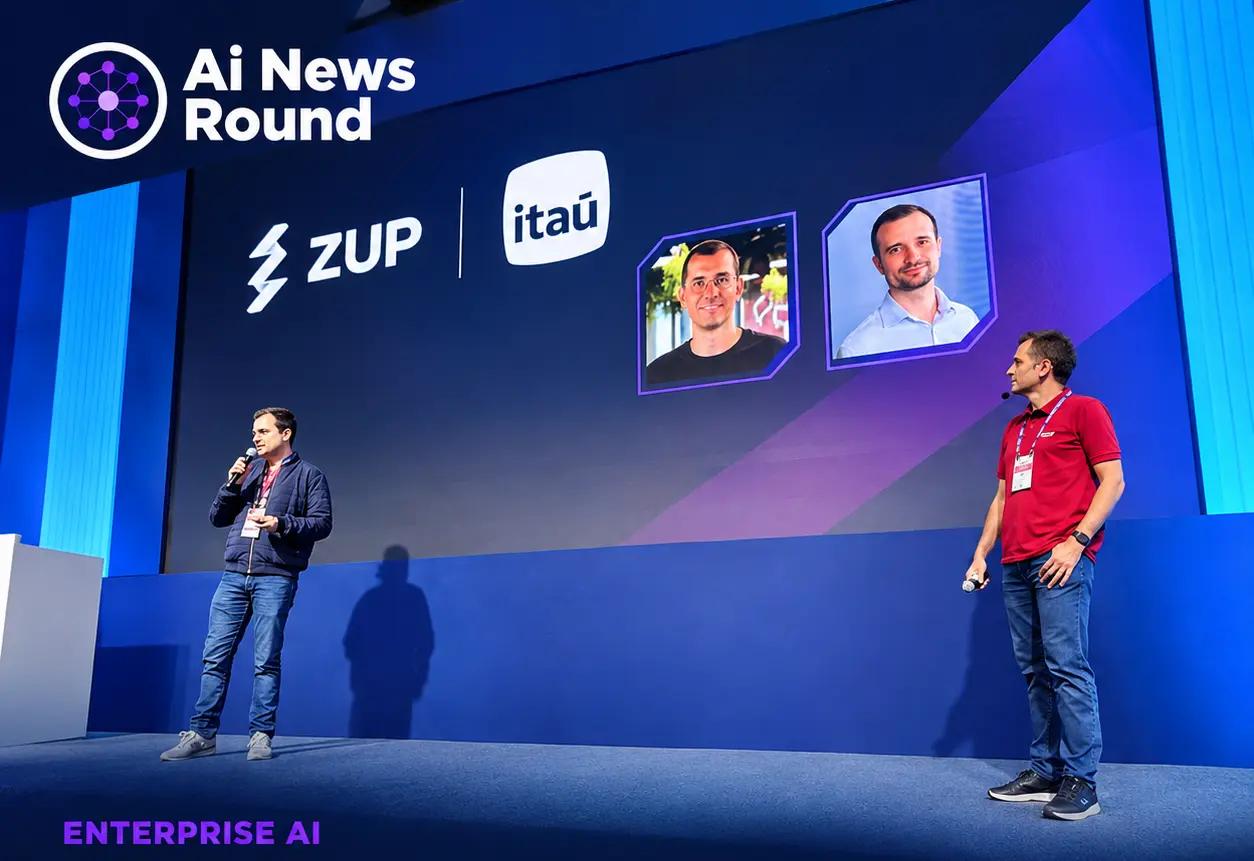
Latin America’s largest private bank, Itaú Unibanco, is deploying a unified generative AI platform to serve its 70 million customers. By pairing AWS cloud architecture with strict internal governance, the institution is scaling digital-agent services while maintaining enterprise compliance and client trust.
Meta Superintelligence Labs has launched Muse Spark Open, an 816-billion-parameter open-weight Mixture-of-Experts model featuring 42 billion active parameters and a 1-million-token context window. Optimized for agentic coding and native multimodal processing across text, audio, image, and video, the model introduces hardware optimizations for local and cloud infrastructure.
Black Forest Labs has released FLUX.3 Image Klein, a 5.6-billion-parameter open-weight image generation and editing model. Arriving with day-one integration in Hugging Face’s Diffusers library, the architecture combines multi-reference image conditioning, coordinate-based bounding box layout controls, and Qwen3-VL text encoding.
A satirical experiment by creator Graham Dot Zip exposing the breakdown between an AI job candidate and an AI recruiter reveals deep risks in delegation. When autonomous bots hallucinate qualifications, undercut reservation prices, and commit without human approval, simple agentic workflows quickly become financial liabilities.
Artificial intelligence startup Reflection AI has released Beam, an open-weight sparse Mixture-of-Experts model boasting 501 billion total parameters and 23 billion active parameters. Released under an Apache 2.0 license, Beam is optimized for code synthesis, complex reasoning, and long-horizon agentic workflows.
A formal verification study by independent researcher Adarsh Agrawal demonstrates that providing correctness feedback during completeness audits in Verus inadvertently erases evidence of incomplete contracts. The paper introduces a phase-separated workflow that more than doubles certified witness discovery rates.
The Mirage of HTTP 200 and Execution-Level Success
In traditional software development, systems fail loudly: API calls throw exceptions, code exits with error codes, and monitoring alerts trigger immediate investigation. However, as data science teams deploy multi-agent systems—where foundation models act as reasoning engines to clean datasets, formulate hypotheses, execute SQL queries, and train
Google has officially released Gemini 4 Argon, the flagship reasoning model of its new Gemini 4 generation. Built for complex, multi-step tasks across software engineering, legal research, and quantitative finance, Argon introduces expanded agentic execution and leads performance on the Vals Index.
Generative AI platform Higgsfield has updated its workflow engine to extend AI video creation from single short-form clips into fully assembled videos running over 10 minutes. The platform leverages multi-scene stitching, model aggregation, and autonomous script orchestration.
Cybersecurity provider Sophos has integrated OpenAI's Daybreak framework into its Managed Detection and Response (MDR) platform, slashing threat investigation times from 38 minutes down to 89 seconds. The AI-driven architecture now resolves 52 per cent of security cases end-to-end.
Enterprise work management platform Asana has achieved a 76-fold reduction in per-run model costs for its StackAI browser automation agents. By pairing OpenAI's newly released GPT-6.1 Sol model with append-only prompt caching strategies, Asana also accelerated agent execution speeds fivefold.
OpenAI has launched GPT-6 across ChatGPT, pairing the model family with an Intelligent UI framework that generates interactive charts, forms, and custom tools directly in conversation. The update introduces streaming execution to accelerate web-search answers.
Artificial intelligence voice developer ElevenLabs has doubled its market valuation to $22 billion after completing a $300 million employee tender offer. The rapid growth is backed by surging corporate adoption, with enterprise clients now accounting for the majority of revenue.
2 min read
Get a notification when something new is published.
Done. To stop them later, use the notification settings for this site in your browser.