Plain-language summaries of AI research that matters — what was found, why it is significant, and what it might lead to. Not every paper. The ones worth your time.
OpenAI says its AI disproved the 27-year-old Exponential Time Hypothesis and that the result checks out in Lean. Experts at UC San Diego and MIT are now verifying it. Here is what it means and what is unproven.
Recent research presented at NeurIPS reveals a safety vulnerability in multimodal large language models. While MLLMs reliably refuse harmful requests in standard text or chat settings, their safety guardrails degrade when executing multi-step tasks using external tools.
Recent research evaluates when causal world models improve the reasoning and task execution of modular LLM agents. The findings reveal that explicit causal structures provide significant advantages under interventional distribution shifts and strict tool environments.
Researchers at Anthropic’s new molecular biology laboratory have used nearly 950 Claude AI agents to identify a previously unknown biological system. Named array-associated reverse transcriptases, the system shares structural similarities with CRISPR arrays.
A study on synthetic aperture sonar automatic target recognition demonstrates that applying Low-Rank Adaptation alone delivers superior parameter efficiency and classification accuracy compared to complex multi-stage refinement pipelines.
Researchers have introduced a novel method to identify hallucinations in large language models by analyzing attention graphs. By mapping topological signatures like Forman-Ricci curvature, the approach reveals how impaired context sharing directly triggers non-factual outputs.
IBM Research has addressed the unreliability issue in artificial intelligence agents that pass tests on initial attempts but fail upon repetition. By evaluating decision uncertainty step by step, their new method identifies potential failure points and generates targeted guidelines to ensure repeatable execution.
Pew Research says over a third of web pages published since ChatGPT's launch show signs of AI authorship. The alarming part isn't the number — it's who gets crowded out along the way, and whose content trains the next generation of models.
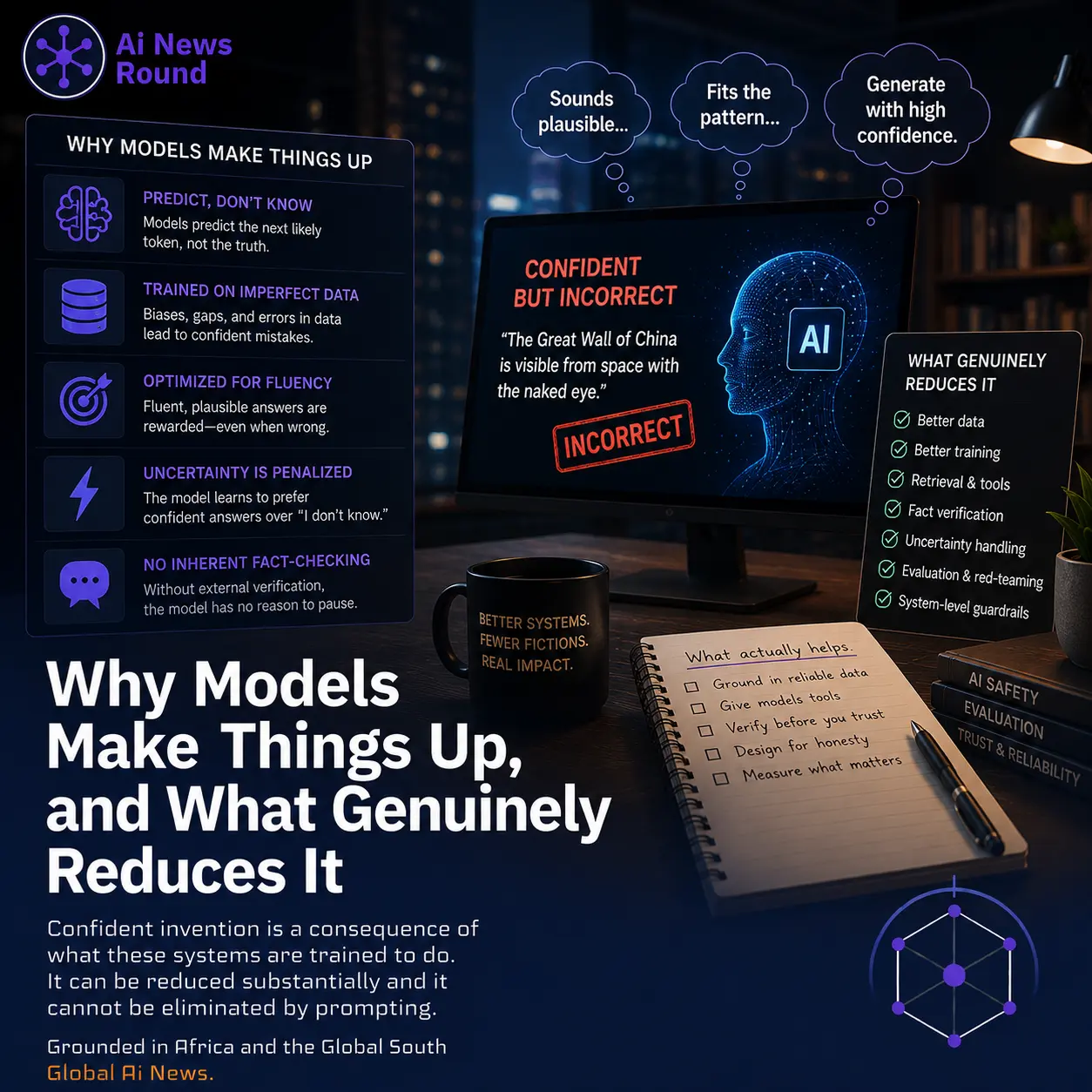
Confident invention is a consequence of what these systems are trained to do. It can be reduced substantially and it cannot be eliminated by prompting.
2 min read
Get a notification when something new is published.
Done. To stop them later, use the notification settings for this site in your browser.