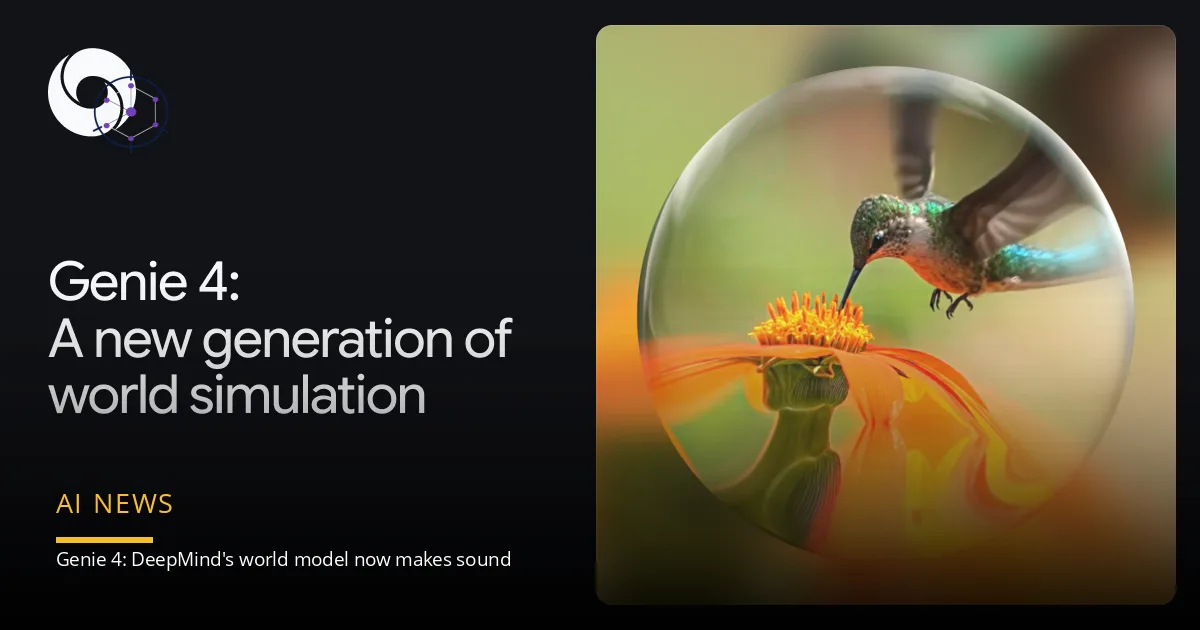
Google DeepMind has released Genie 4, the latest version of its world model, a system that generates an interactive scene you can move through in real time. The headline change in Genie 4 is sound: for the first time, the model produces music, ambient noise and spoken dialogue together with the picture, instead of leaving a silent world for someone else to score.
DeepMind announced the model on 27 October 2026 in a post written by Raia Hadsell, Diego Rivas and Hang Qi. It is not open to the public yet. Below is what the company says the model can do, who can get at it, and the problems DeepMind itself says remain unsolved.
What Genie 4 does
A world model is different from a video generator. A video model produces a fixed clip. A world model keeps producing the next moment based on what you do, so it behaves more like a game engine than a film. You move with ordinary keyboard controls, and the scene responds.
According to DeepMind, Genie 4 draws on the Gemini family of models. Gemini Omni anchors how things look and behave, while other Gemini models handle the reasoning that keeps a scene consistent as it runs. The company lists four main abilities:
- Native audio. DeepMind calls Genie 4 "our first real-time world model to generate audio natively". Music, background sound and conversation come out of the same model as the visuals.
- Steering with text. While a scene is running, you can type an instruction to change the weather, move the camera, or add a person or an object. Gemini adapts the request to what is already on screen.
- Physics and human movement. The post says the model simulates things like aerodynamics and collisions, and that characters move naturally and react to their surroundings.
- Planning agents. In one setup, a Gemini model the post names as Gemini 3.8 Flash watches the frames, splits a goal into steps, checks whether each step worked and changes its plan when the world or the user changes something.
The robot demo
One example in the announcement shows Apptronik's Apollo humanoid robot playing checkers, simulated by Genie 4 working alongside a Gemini model. It points at one of the less obvious uses for world models: giving robots and software agents a place to practise before they act in the real world.
Who can use Genie 4 today
For now, very few people. DeepMind describes Genie 4 as a research preview available to trusted testers. The company says it plans to bring it to three groups next:
- Google AI Ultra subscribers, through Project Genie, the consumer experiment that carried the earlier model.
- Early-access partners of the Gemini API.
- Early-access partners of Google AI Studio.
There is a waitlist form linked from the announcement. DeepMind has not published a price, a general release date or a list of supported countries. That last point matters for readers in Africa: Google AI Ultra is a premium subscription that is not sold everywhere, so access through Project Genie may depend on where you live. Until Google says otherwise, developers on the continent are more likely to reach Genie 4 through the Gemini API partner route than through the consumer app.
What testers are using it for
DeepMind says its testers come from creative industries, journalism, education, gaming and engineering, and that some enterprise partners are testing it for fast scenario generation. The use cases it describes include:
- Filmmakers blocking out scenes before a shoot, known as previsualisation.
- Turning archival photographs into explorable simulations.
- Prototyping game ideas without building assets first.
The archival photo idea is the one that raises the most questions. A walkable version of a historical photograph is a reconstruction, not a record, and anyone using it in a classroom or a news story will need to say so clearly.
Safety and watermarking
DeepMind says it ran internal safety evaluations before the preview and applies the same content guardrails it uses for its other models. Every video and audio output from Genie 4 will carry SynthID, Google's invisible watermark. The company says the watermark covers both the visual and the audio track, which matters now that the model can produce speech.
Rolling out to trusted testers first is also part of the safety plan. DeepMind says it wants their feedback before a wider release.
The limits DeepMind admits
The announcement is unusually direct about what still goes wrong. Visual details and object permanence can drift, especially in long sessions, after several edits, or while you move through a scene. In plain terms, something you walked past may look different, or be gone, when you come back.
DeepMind lists these as open research problems:
- Complex physical interactions.
- Accurate real-time audio.
- Legible text inside scenes.
- Spatial accuracy.
- Consistency over long periods.
The post does not give a resolution, frame rate or maximum session length, and it does not offer a side-by-side comparison with Genie 3 beyond saying Genie 4 has better photorealism, smoother movement and native audio. Those numbers will matter to game studios and robotics teams deciding whether the model is useful, so expect them to surface once more testers get access.
Why it matters
World models are becoming a race. Google is betting that a model which can both show and sound like a real place will be useful for training agents, for media production and, eventually, for games. Adding Gemini as a planner inside the loop is the more interesting technical step, because it means the world can be checked and corrected as it runs rather than generated blindly.
For most people, the practical answer today is to join the waitlist and watch for pricing. For more model launches and what they mean for users, see our coverage of Kimi K3.1 Pro and its open weights.
Source: Google DeepMind, "Genie 4: A new generation of world simulation", 27 October 2026.