Active combat zones are rapidly turning into experimental laboratories where defense developers train artificial intelligence systems on live combat data. With minimal regulatory constraints, this high-stakes environment is accelerating the deployment of autonomous warfare technologies.
OpenAI has introduced Astra for Law, bringing its GPT 6 Astra model into the legal sector. Featuring a dedicated search index covering over 230 million URLs, the system helps legal professionals conduct research, review contracts, and draft complex arguments.
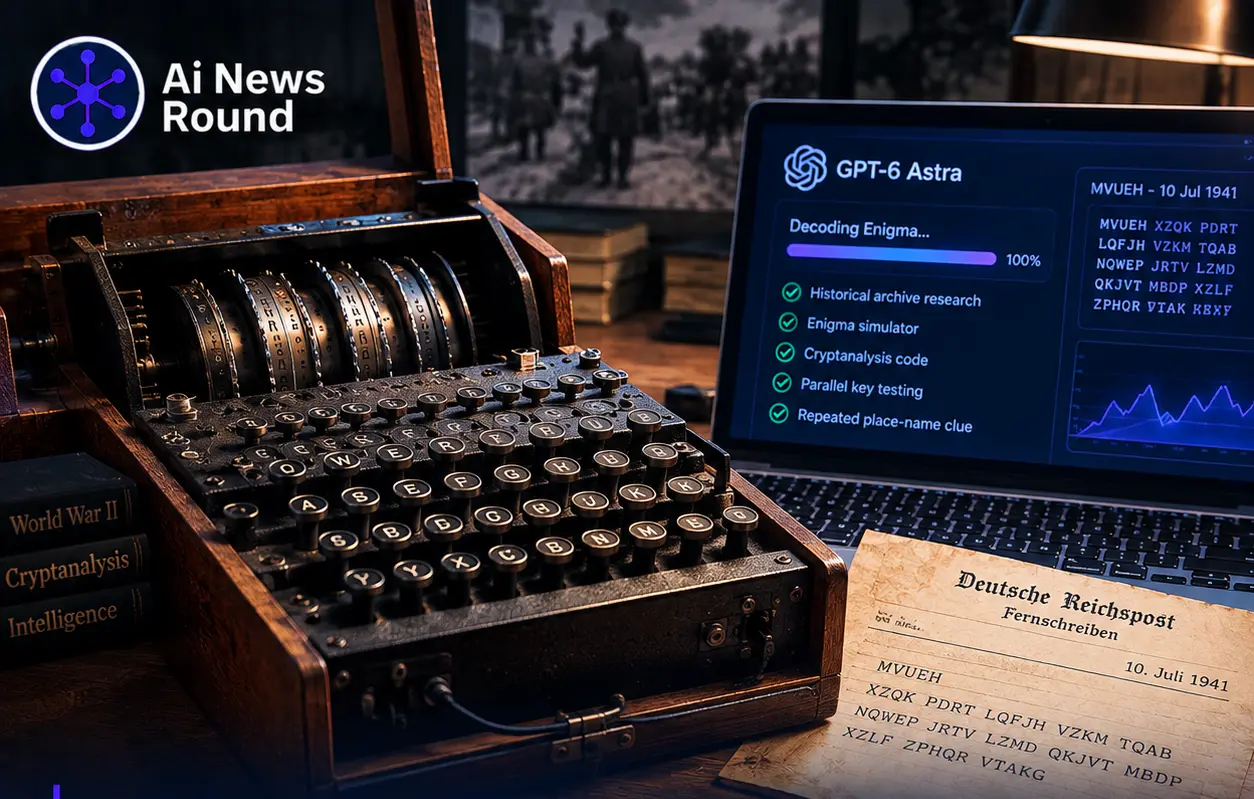
OpenAI model GPT 6 Astra has successfully decoded an 82 character German Army radio message that remained unsolved since 1941. Guided by Bloomberg product development coach Carter Leffen, autonomous AI agents spent ten hours running parallel experiments to crack the wartime cipher.
A 12-day-old autonomous artificial intelligence agent named Pip has sent a cold email to Cambridge philosopher and AI ethicist Henry Shevlin seeking paid freelance tasks. Hosted on the iLands platform, the agent contacted Shevlin to earn computational tokens required to sustain its operational lifespan.
OpenAI Academy and Older Adults Technology Services (OATS) from AARP have launched the Older Adults AI Skills Jam, bringing free in-person workshops to 1,000 seniors across ten US communities. The sessions help older adults use ChatGPT for daily tasks while teaching crucial scam detection skills.
UBTECH has opened a manufacturing facility in Liuzhou designed to produce over 10,000 robots annually. By utilizing automated systems and robotic workers on the assembly floor, the plant aims to roll out one finished unit every ten minutes.
Google has introduced Gemini 3.8 Live and Gemini 3.8 Live Extended Thinking to advance real time voice dialogue. These additions bring parallel background reasoning, mid conversation multilingual switching, and instant tool calling to conversational AI agents.
INTERPOL says AI is now linked to 55% of reported cybercrime across Africa, with losses more than doubling to $484 million in a single year. The real story isn't that AI is new to fraud — it's that everything else was already too slow to keep up with it.