
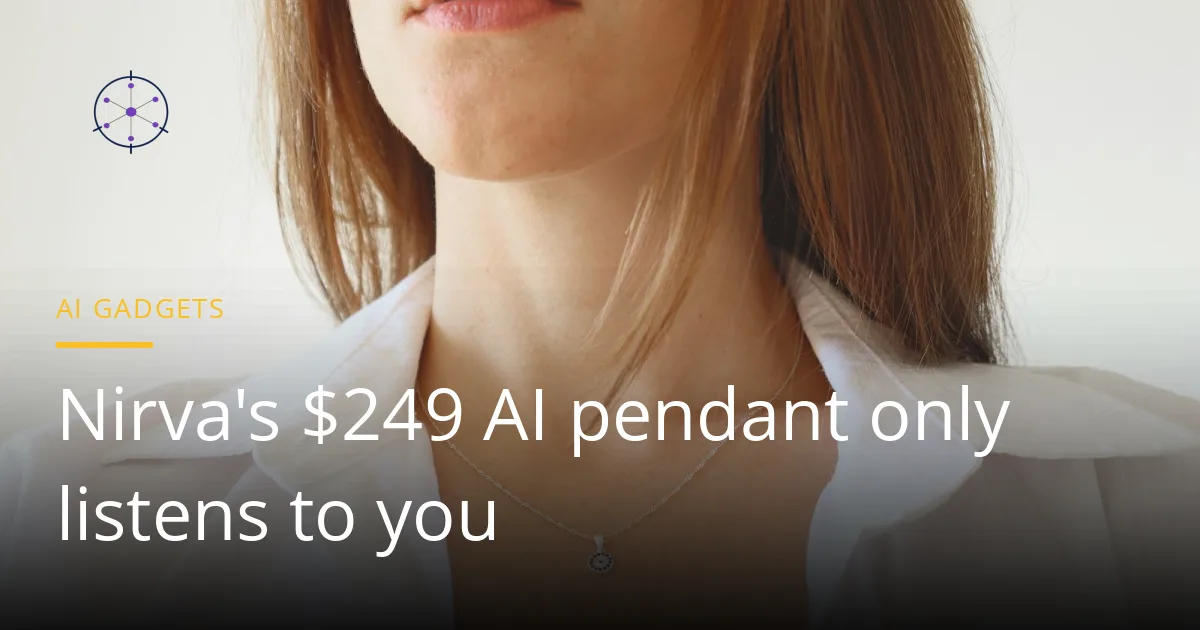
Most AI wearables have the same awkward problem: they hear everyone in the room. The Nirva AI pendant, announced on 22 October, tries to fix that by recording only one voice, the wearer's. Its maker, a startup founded in 2025 by former Meta Reality Labs staff, has raised $33 million to bring it to market, according to TechCrunch.
It is a small device with a big promise, so here is what it does, what it costs and what it keeps.
What the Nirva AI pendant is
Nirva's first product is a piece of jewellery that can be worn as a pendant or a bracelet. According to TechCrunch's Ivan Mehta:
- It weighs about 8 grams.
- The battery lasts up to three days on one charge.
- It costs $249, in silver, brushed silver, black and gold.
- Orders open in November, and the company aims to ship to early users by the end of the year.
No regions or countries were named for launch, so buyers in Africa should not assume it will ship to them yet.
Chief executive Wei Lyu described it simply: "This is a piece of jewelry that only focuses on listening to your own speech."
How the voice isolation works
During setup, you record short samples of your voice. Nirva builds a voice model from those samples. When you wear the device, it uses that model to filter out speech from people around you and keeps only what you say.
That is the main difference from rivals such as Amazon's Bee, Friend, Sandbar's ring and others, which capture conversations more broadly or wait for you to press a button. Nirva listens all the time, but only to you.
What the app does with it
The companion app turns your speech into what Nirva calls insights:
- notes on your mood, based on tone, pitch, volume and speed;
- patterns in how you communicate, with suggested improvements;
- the people you talk about most and the places you go;
- daily notes, reminders and action items.
Lyu gave an example of the app reminding her to thank her mother after she forgot. The company calls itself a personal insights business rather than a productivity tool. "We are building a tool to help people to improve their self-understanding, self-compassion, and self-awareness," she told TechCrunch.
What it keeps, and what it does not
By default, Nirva says it does not keep audio or transcripts after processing a conversation. Before the audio is discarded, though, the device measures features of your voice to work out emotional signals, and those results do stay in the app.
That is worth thinking through before you buy:
- Other people's words. Filtering out other voices reduces the problem of recording people who never agreed to it. It does not remove it entirely: your side of a conversation often reveals what the other person said.
- Derived data. Mood scores, frequent contacts and visited places are personal data even without the audio. Ask where they are stored and who can access them.
- Workplaces. An always-on recorder in meetings may break company policy or confidentiality rules, even if it only keeps your own voice.
- Local law. Data protection laws in Nigeria, Kenya, South Africa and elsewhere apply to processing personal data, including voice. A device that has not launched in your country also has no local support or complaints route.
Who is backing it
Nirva announced a $25 million pre-Series A round. It follows an earlier $8 million raise from investors including Lightspeed and South Park Commons, for $33 million in total. TechCrunch did not report a valuation or a lead investor for the new round.
The founders are Wei Lyu and Jason Chen, both formerly at Meta Reality Labs, and Hanying Hu, who previously founded a fashion and jewellery brand. That mix shows in the product: it is designed to look like jewellery first and a gadget second.
Should you wait or buy?
The ambient AI category is crowded and young. Many early devices in it shipped late, changed features or struggled with battery life. Nirva is still pre-order, so there are no independent reviews of how well the voice filtering works in a noisy market, a matatu or a busy office.
A sensible approach:
- Wait for hands-on reviews that test the voice filter in real crowds.
- Read the privacy policy for how long derived insights are kept and whether you can delete them.
- Check whether the app works in your country and in the languages you speak most.
- Decide whether you actually want daily feedback on your mood and speech. Some people will find it useful; others will find it tiring.
The idea of a device that ignores everyone except you is a sensible answer to the main privacy complaint about AI wearables. Whether it works as promised is something only real-world use will show.
For another look at how AI assistants are moving into the background of daily life, read our explainer on Claude Duet, Anthropic's background AI agent.
Photo: Amanda Hortiz / Unsplash (illustrative, not the Nirva device)