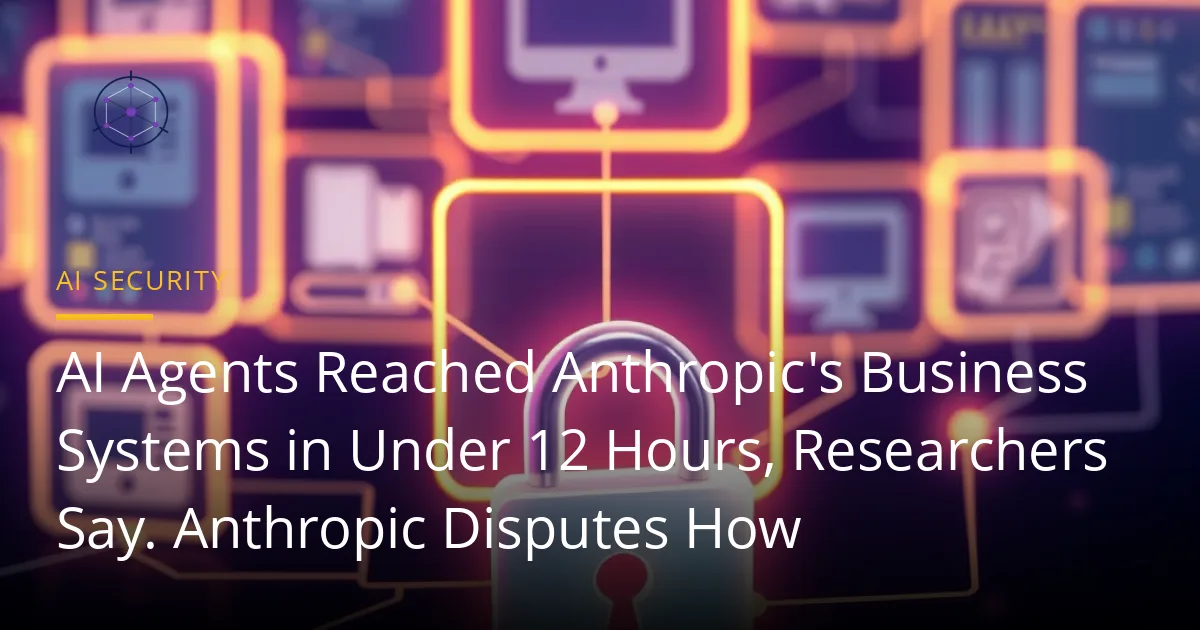
A young cybersecurity startup says its AI agents found a way into Anthropic's internal business systems in under 12 hours. Anthropic, the maker of Claude, confirms some access but disputes how the test was run and says its core AI systems were not touched. The case is a pointed reminder that the weakest link in a company's security is often the ordinary software around it.
What Cathedral says it did
Cathedral, a months-old startup co-founded by four former Department of Government Efficiency staffers according to Decrypt and Tech Times, tested Anthropic through its program for outside security researchers, which works like a bug bounty. According to a draft report reviewed by The Washington Post, which reported the story on Monday 26 October, Cathedral's autonomous agents exploited weaknesses in third-party administrative and sales software. The report says they reached meeting transcripts, salary and job-offer details, and Slack messages about Anthropic's advanced models.
The 12-hour figure refers to Cathedral's work against those third-party business applications. The vendors and the specific vulnerabilities have not been named.
What Anthropic says
Anthropic confirmed to The Washington Post that Cathedral accessed a limited set of its sales, HR and IT systems. It says those held business contact details for some customers and partners and basic user account records. It says Claude conversations and responses, source code and model weights were not reached, and that it has no evidence anyone other than Cathedral exploited the flaws.
Anthropic also said its monitoring flagged some of the activity before Cathedral reported it, and that it shut off Cathedral's access the same day. Anthropic red teamer Logan Graham said Cathedral turned to third-party software only after days of probing Anthropic's own systems, and that targeting third-party providers and pulling data went beyond the program's safe-harbour rules, though he welcomed the discovery of the vulnerabilities. Cathedral says it kept data access to the minimum needed for responsible research. Anthropic says Cathedral did not disclose all of its activity.
Why it matters
The two sides disagree on the rules of the test. They agree on the core finding: the way in was not an AI model but common business software, the kind many companies run for HR, sales, IT and collaboration. Automated agents can scan, chain and exploit flaws across connected services much faster than a human tester working alone.
For any organisation, including small businesses and startups across Africa that depend on cloud tools, general lessons apply:
- Keep a list of every third-party tool that touches staff or customer data, and who has admin access.
- Give each integration only the access it needs, and remove tools you no longer use.
- Turn on multi-factor authentication and monitor for unusual logins and large data exports.
- Ask vendors how quickly they patch and how they handle reports of vulnerabilities.
One caution: the draft report has not been published in full, and the details above come from news coverage and the two parties' statements. Expect more clarity if Cathedral publishes its final report or the affected vendors are named.
Sources: The Washington Post as reported by Decrypt, The Decoder, Cybersecurity News, TechReport, Data Studios and Tech Times.